
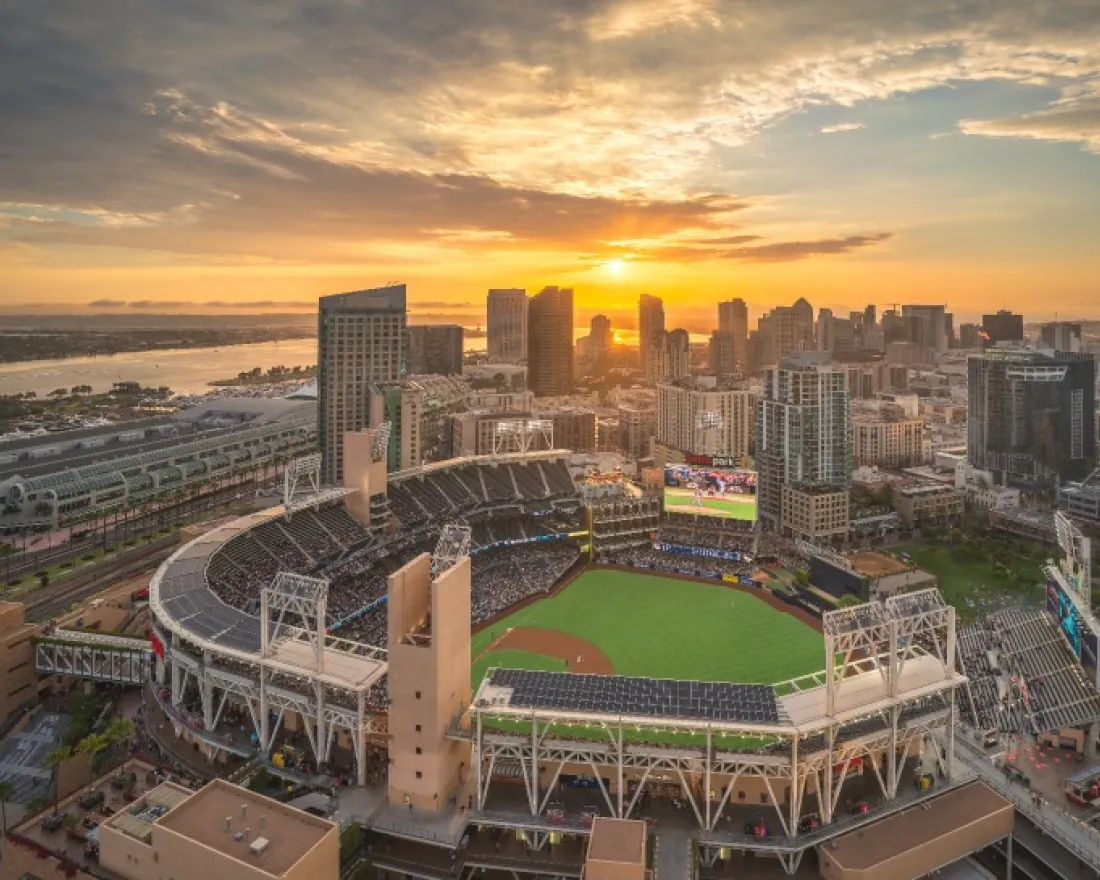
Inside Petco Park: A New Model for Sustainable Events
On game day at Petco Park, everything is built for scale.
More than 40,000 fans pass through the gates. Thousands of meals are served. Drinks are poured, packaging is unwrapped—and by the final inning, the question lingers:
What happens to it all? The answer isn’t visible from the stands, but it’s happening all around the ballpark. At Petco Park, waste isn’t treated as a single stream. Behind the concourses, materials are separated in real time—recyclables, compostables, cooking oil, cardboard, even electronics and uniforms—each routed into its own recovery stream rather than heading straight to landfill.
In a recent season, the San Diego Padres diverted nearly 15,000 tons of waste, achieving a 96% diversion rate.
What Happens to the Food? Food is one of the biggest opportunities to rethink waste at a venue this size.
At Petco Park, organic material is collected and sent to composting facilities, where it can be processed back into usable soil. In one year alone, more than 850 tons of organic waste and compostable service ware were diverted this way.
But some food doesn’t go to compost at all. More than 46 tons of surplus food have been donated to local organizations like Father Joe’s Villages, extending its impact beyond the ballpark.
Behind the scenes, the Padres have reworked the infrastructure itself:
- A streamlined two-bin system aligned with California’s organics recycling law
- Compostable service ware tested to break down locally
- Dedicated sorting teams ensuring materials end up in the right place
The result is less about asking fans to get it right every time—and more about designing a system that works at scale. Look up, and the system extends even further.
Installed along the upper deck canopy is a 336-kilowatt solar array made up of more than 700 panels, generating over 1 million kilowatt-hours of renewable energy each year. It’s the largest solar installation in Major League Baseball—producing more solar energy than all other MLB ballparks combined. The panels help power daily operations, while an on-site battery system stores energy and reduces demand during peak hours.
Combined with San Diego’s renewable energy grid, the result is a ballpark operating on 100% renewable electricity.
The approach extends outside the stadium, too. The transformation of Gallagher Square introduced native landscaping, stormwater capture features and a zero-waste construction process that recycled or reused the majority of materials from the project. It’s the same philosophy applied at a different scale: rethink inputs, reduce waste, design for long-term use.
For meeting planners and event organizers, venues like Petco Park offer something increasingly important: sustianability at scale.
If a stadium can manage waste, energy and operations across 40,000 attendees—diverting most materials from landfill while running on renewable power—it changes the conversation around what’s possible for large events. It also shifts expectations. Sustainability isn’t a side initiative—it’s becoming part of how venues operate.
Most fans leave Petco Park thinking about the game, the score, the atmosphere, the night out in downtown San Diego. But long after the stadium empties, another process is still underway. Materials are sorted. Food is recovered. Energy continues to flow from panels overhead. And in a place built for big moments, it’s often the systems you don’t see that are quietly reshaping what a large-scale event can look like.